
BGS Black Label: What It Is and Why It Sells
What is a BGS Black Label? How Beckett's four subgrades work, how Black Label differs from Pristine 10, and why it can multiply a card's value.
In the high-end card market, few labels carry the prestige of a Beckett Black Label. A BGS Black Label marks a card that Beckett judged perfect in every category it measures. On the right card, that perfection sells for a large premium. In March 2021, a 1996-97 Topps Chrome Refractor Kobe Bryant in BGS 10 Black Label sold at Goldin for $1,795,800, and Beckett reported it was one of only two Black Label copies. This guide explains how the Black Label is earned, how it differs from a regular Pristine 10, and when it is worth chasing.
How BGS Grading Works: Four Subgrades
Beckett Grading Services (BGS) grades every card on four subgrades, each on a 1–10 scale in half points:
- Centering: how evenly the image is framed, front and back.
- Corners: sharpness and any wear.
- Edges: chips, roughness and notches.
- Surface: scratches, print lines, dents and other defects.
The overall grade is based on those four subgrades, and a weak subgrade tends to limit the final number. The subgrades are printed on the label, so buyers can see exactly where a card fell short.
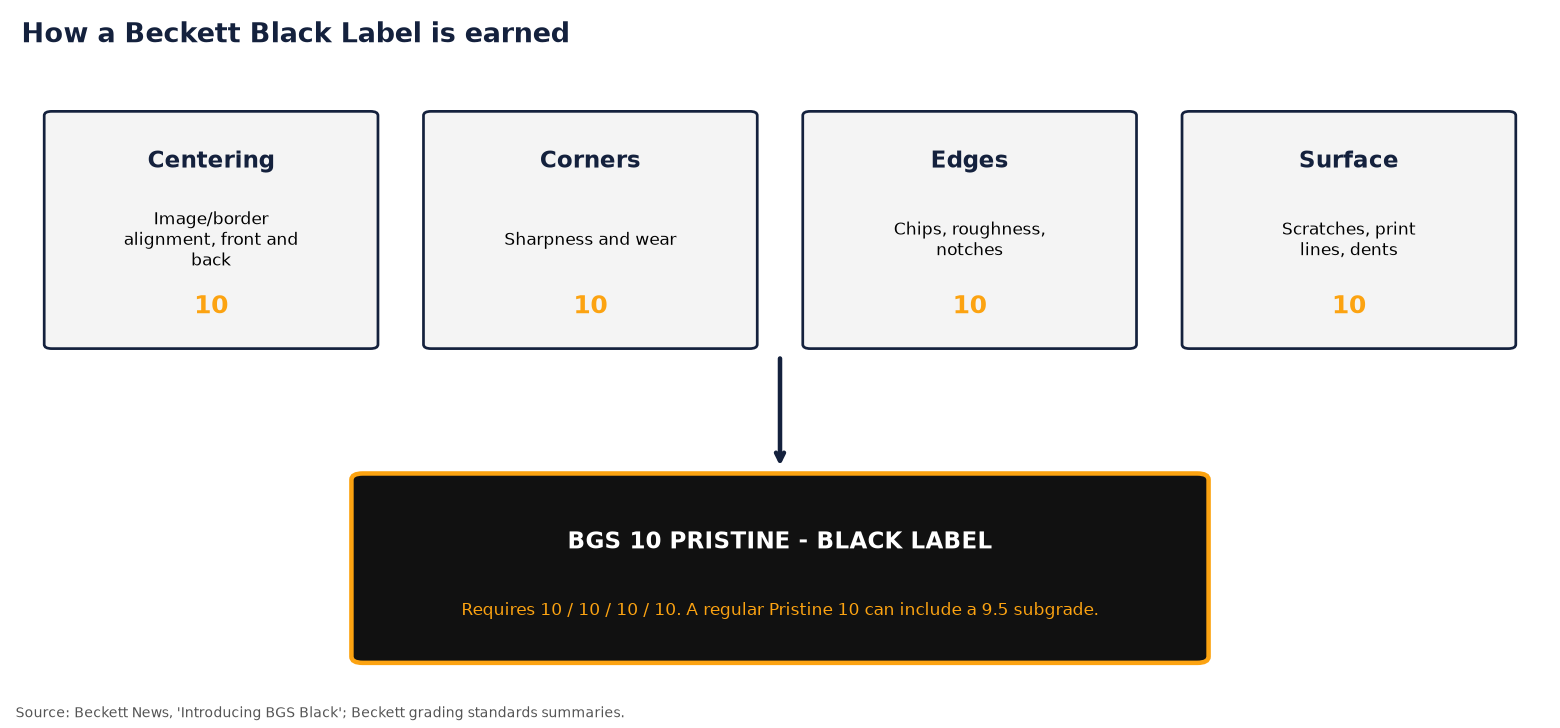 Figure: A Black Label requires a perfect 10 in all four subgrades (Beckett).
Black Label vs Pristine 10 vs Gem Mint 9.5
BGS 10 Pristine (regular)
A Pristine 10 is Beckett's top numeric grade, but it does not require four perfect subgrades. A regular Pristine 10 can include one or more 9.5 subgrades.
BGS 10 Black Label
A Black Label requires 10/10/10/10: perfect centering, corners, edges and surface (Beckett, "Introducing BGS Black"). That is a much higher bar than a regular Pristine 10, and only a tiny share of cards reach it.
BGS 9.5 Gem Mint
The most common "gem" grade on modern BGS slabs. A 9.5 with strong subgrades, such as three 10s and one 9.5, is valued well above a 9.5 with weaker subgrades.
| Grade | Subgrade requirement | Typical market view |
|---|---|---|
| BGS 10 Black Label | All four subgrades = 10 | Extremely scarce; can carry a major premium |
| BGS 10 Pristine | Overall 10; 9.5 subgrades allowed | Scarce; strong premium |
| BGS 9.5 Gem Mint | Overall 9.5 | Common benchmark for modern BGS |
Why Black Labels Command Such Prices
Extreme scarcity
Black Labels are scarce by design. The Kobe Topps Chrome Refractor that sold for $1,795,800 was one of only two Black Label copies at the time of sale (Beckett).
Objective "perfection" on the label
Subgrades show buyers that a card scored perfectly in every category. That kind of certainty appeals to collectors who want the single best example of a card.
Registry and competition
Collectors who compete to own the best examples of a set or player push up prices for the few cards that cannot be beaten.
Black Label vs PSA 10
PSA does not print subgrades. Its Gem Mint 10 requires front centering of about 55/45 or better (PSA). Because the grading systems differ, the market treats the two grades differently:
- A PSA 10 is the liquid benchmark for many modern cards, because PSA grades far more cards. PSA graded 15.34 million cards in 2024, compared with Beckett's 657,000 (Sports Illustrated).
- A BGS Black Label is rarer and can sell for well above a PSA 10 of the same card, but there are fewer buyers and fewer comps.
- A regular BGS 9.5 often trades below a PSA 10 on modern cards. Graded Card Investor's Luka data notes that PSA 10s "consistently command higher prices than BGS 9.5s" for some of his rookie cards.
For the full comparison, see PSA vs BGS vs SGC.
Which Cards Are Black Label Candidates?
Chromium and refractor cards
Modern chromium cards (Topps Chrome, Prizm, Optic) come out of packs in good shape more often than vintage cardboard, and buyers value perfect examples highly. The Kobe Topps Chrome Refractor is the classic example.
Thin, clean, well-centered cards
Thick memorabilia cards rarely get perfect edge and corner subgrades. The $5.2 million LeBron Exquisite RPA /23 was a BGS 9, and Forbes noted that it was still the third-best-graded example. Patch-heavy grails are judged on different expectations.
Not every card benefits
If a card's market sits mostly in PSA slabs, a Black Label may not earn a premium big enough to justify the risk of chasing one. Check sales history before you submit with that goal.
How to Judge a Card's Black Label Chances
- Centering: measure front and back. Anything visibly off-center rules out a 10 centering subgrade.
- Corners: inspect under magnification for any whitening or softness.
- Edges: look for even the smallest chipping, especially on colored borders.
- Surface: use angled light to find print lines, dimples or scratches, which are common on chromium.
- Handling: move cards straight from the pack into a sleeve and a rigid holder to avoid adding flaws.
Our grading guide walks through the submission decision step by step.
Risks and Realities
- Odds are low. Even pack-fresh cards seldom get four perfect subgrades.
- The premium depends on the card. A Black Label is valuable mainly where the market tracks BGS slabs and where the player is in high demand.
- Comps are thin. With so few copies, one sale can move the perceived value a lot.
- Cracking slabs is risky. Removing a high-grade card from a holder to resubmit it can lower the grade.
Reading the Pop Report for Black Labels
Beckett's population data separates Black Label counts from regular Pristine 10s. Check how many Black Labels exist for your card before you pay a premium. A "pop 1" or "pop 2" Black Label is a very different asset from a card with dozens. Our pop report guide explains the general method.
Kobe and the Black Label Benchmark
The 1996-97 Topps Chrome Refractor Kobe is the benchmark Black Label sale in basketball. Its $1,795,800 price came during the 2021 boom, and it set the standard for how far a perfect grade can lift an iconic rookie card. For more on Kobe's market, see our Kobe Bryant rookie card guide.
FAQ
What is a BGS Black Label?
A Beckett Pristine 10 with perfect 10s in all four subgrades: centering, corners, edges and surface.
Is a BGS 10 the same as a Black Label?
No. A regular BGS 10 Pristine can include 9.5 subgrades. A Black Label requires four 10s.
Is a BGS Black Label worth more than a PSA 10?
Often, yes, on cards where buyers follow BGS, because Black Labels are far scarcer. A PSA 10 is usually more liquid.
What is the most famous Black Label basketball card sale?
The 1996-97 Topps Chrome Refractor Kobe Bryant BGS 10 Black Label, which sold for $1,795,800 at Goldin in March 2021.
What does a BGS 9.5 mean?
Gem Mint. It is Beckett's most common high grade for modern cards. The subgrades show how close the card came to a 10.
Should I submit my cards to BGS hoping for a Black Label?
Only if the card is a strong candidate, such as a clean, well-centered chromium card from a fresh pack, and its market actually pays a Black Label premium. Otherwise, a PSA 10 may be the more liquid result.
Related Articles (Internal Links)
- PSA vs BGS vs SGC: Best Grader for Basketball Cards
- PSA Grading Scale Explained: 1 to Gem Mint 10
- Kobe Bryant Rookie Cards: Values, Records & Key Cards
- How to Grade Basketball Cards: Is It Worth It?
- How to Read a PSA Pop Report (With Examples)
Sources
- Beckett News, "Introducing BGS Black". https://www.beckett.com/news/introducing-bgs-black/
- Beckett News, "Kobe Bryant 1996-97 Topps Chrome Refractor BGS 10 Nets $1.8 Million" (Mar 2021). https://www.beckett.com/news/1996-97-topps-chrome-refractor-kobe-bryant-bgs-10-black-label-sells-1-8-million/
- Sports Illustrated Collectibles, "20 Million Cards Were Graded In 2024". https://www.si.com/collectibles/20-million-cards-were-graded-in-2024
- PSA, "Grading Standards". https://www.psacard.com/gradingstandards
- Reuters, "'Ultra-rare' LeBron rookie card sells for record-breaking $5.2 million" (Apr 26, 2021). https://www.reuters.com/lifestyle/sports/ultra-rare-lebron-rookie-card-sells-record-breaking-52-million-2021-04-27/
- Forbes, "Most Expensive Basketball Card Ever: LeBron James Rookie Card Sells For $5.2 Million" (Apr 27, 2021). https://www.forbes.com/sites/tommybeer/2021/04/27/most-expensive-basketball-card-ever-lebron-james-rookie-card-sells-52-million/
- Graded Card Investor, "Best Luka Doncic Rookie Cards - Recent Prices & Value" (late 2023). https://gradedcardinvestor.com/top-20-luka-doncic-rookie-cards-to-buy-now/
Figures are reported prices from the cited sources at the time of research (October 2026). Private-sale prices are as reported and were not independently audited. Nothing here is financial advice.