
Sports Card Insurance: How to Protect Your Collection
Sports card insurance explained: homeowners sublimits, scheduled personal property and floaters, specialist collectibles policies, valuation and claims.
A single high-end basketball card can now be worth as much as a house, and some are worth far more. Yet many collectors assume their homeowners or renters policy covers their cards, without checking the limits. Often it does not cover them fully. This guide explains how sports card insurance works: the gaps in standard policies, the main ways to insure a collection properly, how to document and value your cards, and how to handle claims and shipments.
This is general information, not insurance or legal advice. Policies vary by insurer and state, so confirm the details with a licensed agent.
The Six-Step Insurance Process
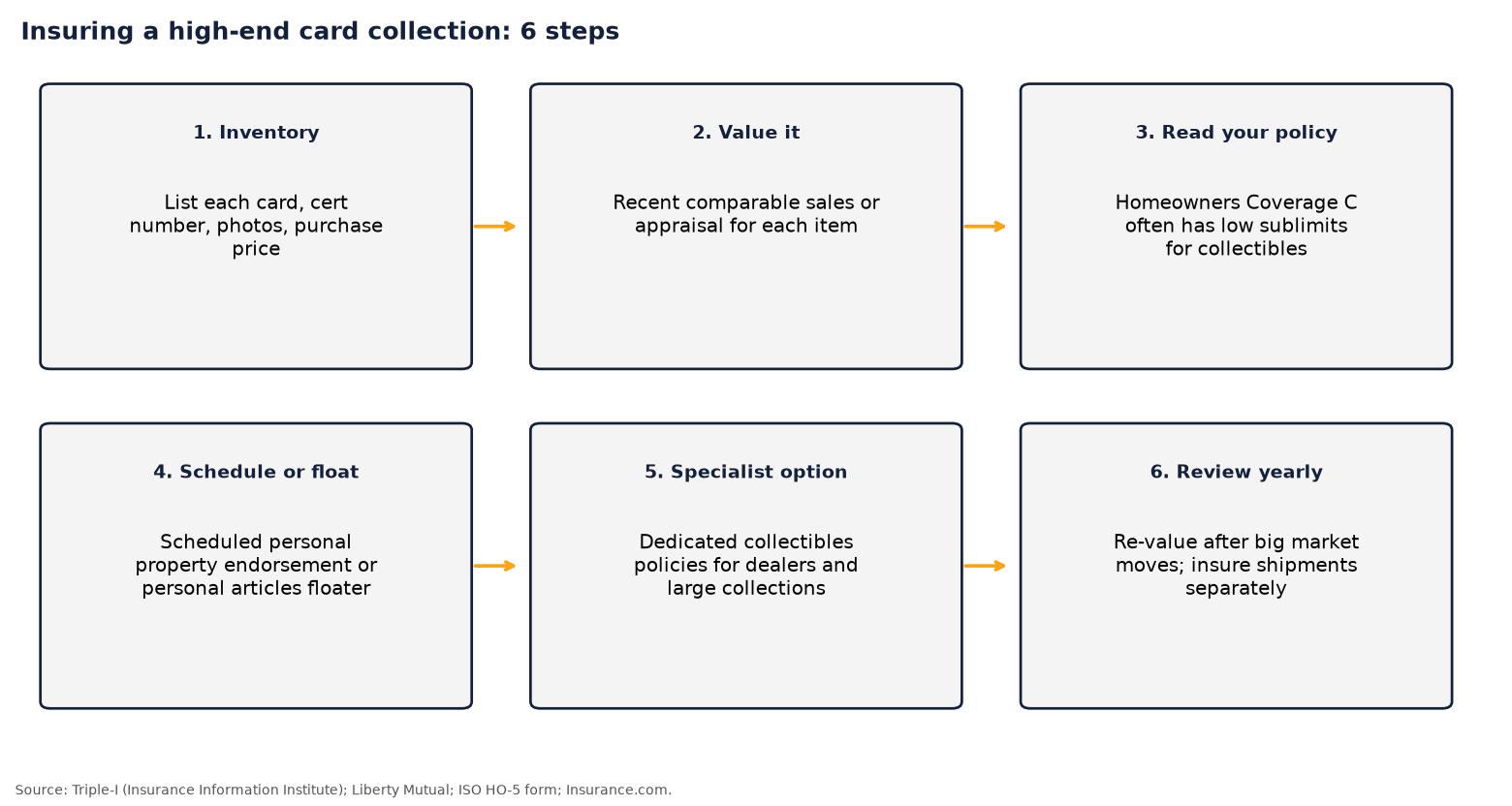 Figure: A six-step process for insuring a high-end card collection.
Step 1: Build a Complete Inventory
Insurers pay claims on what you can prove. For each card, record:
- Player, year, set, card number and parallel or serial number
- Grader, grade and certification number. Verify each cert on the grader's website, such as PSA Cert Verification.
- High-resolution photos of the front and back
- Purchase date, price, seller and receipt
- Storage location, whether home, safe or vault
Keep a copy off-site, for example in cloud storage, so a fire or theft does not destroy your records along with your cards.
Step 2: Establish Current Value
Card values change quickly. Examples from our research:
- A LeBron Topps Chrome Gold Refractor PSA 10 sold for $1.2 million in 2022, $645,000 in 2024 and $1.11 million in 2026 (Yahoo Sports).
- PSA's Auction Prices Realized pages show recent sales by grade, a useful starting point for documenting value.
For high-value cards, consider a formal appraisal or a documented set of recent comparable sales. Re-value at least once a year, and after any big market move.
Which number should you insure?
Auction headlines usually include the buyer's premium. When Alt sold the Kobe/LeBron Dual Logoman in September 2026, the winning bid was $5,418,200 and the total with the 20% premium was $6,501,840 (Sports Illustrated). Replacing a lost card means paying the full price a buyer pays, so discuss with your insurer whether the agreed value should reflect premium-inclusive prices.
Step 3: Understand Your Current Policy's Limits
Standard homeowners policies cover personal property under Coverage C, but they often apply special limits (sublimits) to certain categories of valuables. The standard ISO homeowners form, for example, sets category limits for items such as jewelry, silverware and certain collections, and those limits do not raise your overall personal property limit. The Insurance Information Institute (Triple-I) explains that high-value possessions may need additional coverage beyond a standard policy.
Questions to ask your agent:
- Are trading cards covered, and is there a sublimit for collectibles?
- What perils are covered: theft, fire, water, accidental damage, mysterious disappearance?
- Is coverage based on actual cash value, replacement cost or an agreed value?
- What is the deductible?
- Are cards covered away from home, at shows, in transit or in a vault?
Step 4: Schedule Your Cards or Add a Floater
The usual fix for underinsured valuables is a scheduled personal property endorsement or a separate personal articles floater. According to Triple-I, Liberty Mutual and Insurance.com:
- Each item, or the collection as a whole, is listed with an appraised value.
- Coverage is often broader than a standard policy and may include accidental loss.
- Scheduled items may have no deductible, depending on the insurer.
- Check the rules for newly acquired items, which may be covered automatically for a limited time and up to a cap.
Step 5: Consider a Specialist Collectibles Policy
Large or actively traded collections may fit better with a dedicated collectibles policy from an insurer that specializes in the hobby. Compare:
- Valuation method: agreed value or market value at the time of loss.
- Transit and show coverage, which matters if you ship cards to graders or auction houses.
- Vault coverage, and how it interacts with any insurance the vault provides.
- Dealer vs collector status, because frequent selling can change what kind of policy you need.
- Blanket vs per-item limits.
Step 6: Review Every Year
Market swings can leave you overinsured, paying for value that no longer exists, or underinsured, exposed after prices rise. Review your schedule annually, and immediately after you buy a major card or prices jump.
Insuring Cards in Transit
Shipping is one of the riskiest moments in a card's life. Before you send a card to a grader, an auction house or a buyer:
- Check your policy's transit coverage. Many standard policies do not cover cards in the mail.
- Understand carrier declared-value limits and exclusions.
- Ask the grader or auction house how they insure items in their care.
- Document condition with photos before shipping.
- Use tracked, signature-required delivery.
Our guides to grading and selling cover handoff steps in more detail.
Vaults and Insurance
Marketplace vaults store cards in secured facilities. Ask any vault provider:
- What insurance covers your cards, and up to what value?
- Is the value based on your declared value, or on recent sales?
- What happens if a card is lost or damaged in the vault or in transit to a buyer?
Do not assume vault coverage replaces your own policy. Confirm it in writing.
Making a Claim
- Report losses quickly to your insurer and, for theft, to the police.
- Provide your inventory, with photos, certs, receipts and recent comps.
- Show current value using recent public sales of the same card and grade.
- Keep damaged items and packaging until the insurer has inspected them.
- Expect questions about storage and security, and keep that documentation as well.
Storage and Insurance Work Together
Insurers look more favorably on collections stored in safes or vaults with proper environmental controls. Good storage also prevents the slow, uninsurable damage of fading, warping and moisture. See how to store sports cards safely.
Common Insurance Mistakes
- Assuming a homeowners policy fully covers a valuable collection.
- Insuring at purchase price and never updating.
- Having no photos, receipts or cert records.
- Shipping cards without transit coverage.
- Overlooking coverage away from home, at shows or in vaults.
For the bigger financial picture, see investing in basketball cards.
FAQ
Does homeowners insurance cover sports cards?
Usually, up to a point. Personal property coverage applies, but policies often have sublimits for valuable categories and may not cover every peril or loss away from home. Check your policy.
What is a scheduled personal property endorsement?
An add-on that lists specific valuables, or a collection, with appraised values. It typically provides broader coverage than the base policy.
How do I prove what my cards are worth?
Use recent public sales of the same card and grade, auction price databases and, for high-value items, professional appraisals. Update them regularly.
Are cards covered while being graded or auctioned?
Not necessarily. Check your policy's transit and off-premises coverage, and ask the grader or auction house about their insurance.
How often should I update my card insurance?
At least once a year, and right after any major purchase or market move.
Related Articles (Internal Links)
- How to Store Sports Cards Safely: A Collector's Guide
- How to Sell High-End Sports Cards for Top Dollar
- Investing in Basketball Cards: Risks and Real Returns
- How to Grade Basketball Cards: Is It Worth It?
- How to Read a PSA Pop Report (With Examples)
Sources
- Insurance Information Institute (Triple-I), "Insurance for Your House and Personal Possessions". https://www.iii.org/article/insurance-for-your-house-and-personal-possessions
- Liberty Mutual, "How to insure high-value items: art, collectibles, and other valuables". https://www.libertymutual.com/insurance-resources/property/coverage-for-valuables
- ISO Homeowners 5 - Comprehensive Form (HO 00 05) specimen (IIAT). https://www.iiat.org/uploads/files/general/InfoCentral/Homeowners/ho0005.pdf
- Insurance.com, "What is scheduled personal property coverage?". https://www.insurance.com/homeowners-insurance-endorsements/scheduled-personal-property-coverage
- Yahoo Sports, "LeBron James Gold Refractor becomes first million-dollar card of 2026" (Jan 26, 2026). https://sports.yahoo.com/articles/lebron-james-gold-refractor-becomes-220000642.html
- PSA, "Cert Verification". https://www.psacard.com/cert/
- PSA, Auction Prices Realized: 1986 Fleer Michael Jordan #57. https://www.psacard.com/auctionprices/basketball-cards/1986-fleer/michael-jordan/299576
- Sports Illustrated, "One of A Kind Kobe and LeBron Dual Logoman Autograph Card Sets New Sales Record" (Sep 26, 2026). https://www.si.com/collectibles/one-of-a-kind-kobe-lebron-dual-logoman-autograph-card-sets-new-sales-record
Figures are reported prices from the cited sources at the time of research (October 2026). Private-sale prices are as reported and were not independently audited. Nothing here is financial advice.